

PRETORIA – South Africans are keeping vehicles for longer as affordability pressures, rising living costs, and higher borrowing costs continue to reshape ownership trends.
But while consumers spend significant time researching vehicle pricing, fuel economy and monthly repayments before making a purchase, industry experts say one of the most important long-term considerations is often overlooked: the dealership and support network behind the vehicle.
In an automotive market undergoing consolidation, restructuring and increased operational pressure, dealership stability is becoming increasingly important – particularly when it comes to servicing, warranty support, parts availability and long-term customer continuity.
“Buying a vehicle is one of the largest financial commitments many households and businesses make,” says Gordon Ferns, Toyota Divisional Chief Executive at CFAO Mobility Toyota. “For many South Africans, a vehicle can become one of the biggest monthly expenses after housing costs. Yet consumers often focus only on the purchase itself and not the long-term support structure behind that vehicle.”
This shift is becoming increasingly important as South Africans keep vehicles for longer and place greater emphasis on maintenance, reliability and ownership costs.
Why South Africa’s Dealership Landscape is Changing
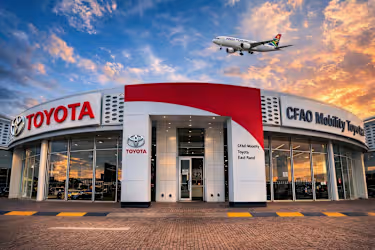
Across South Africa’s automotive sector, several long-established dealerships – many trusted local names for decades – have increasingly become part of larger mobility groups and national dealership networks.
While this type of industry consolidation can initially create uncertainty among consumers, analysts say larger dealership groups are often better positioned to invest in technical training, parts supply infrastructure, servicing capability and operational systems that support long-term customer continuity.
According to Ferns, one of the biggest misconceptions around dealership consolidation is that customers lose the relationships they’ve built with dealership teams over many years.
“In many cases, the same people customers have trusted for years are still there,” says Ferns. “The difference is that those dealerships now have access to significantly greater infrastructure, support systems and operational backing behind them.”
He says the goal is not to remove the identity or relationships customers value, but to strengthen the support structure around them. For customers, the most important thing is continuity. The people they know, the service they trust and the relationships they have built remain in place, now supported by greater infrastructure, resources and long-term backing.
Why After-Sales Support Matters More Than Ever
For many South Africans, vehicles are no longer short-term purchases. Industry analysts say affordability pressures have contributed to consumers extending ownership cycles and delaying upgrades.
As a result, after-sales support has become an increasingly important part of the overall ownership experience.
According to Reuters and Naamsa, South Africa’s automotive industry contributes more than 5% to the country’s GDP and directly employs around 115 000 people across manufacturing, retail, servicing and supply-chain operations.
Industry experts say dealership after-sales divisions and service departments form a critical part of this ecosystem, particularly as consumers increasingly rely on long-term servicing, maintenance support and parts availability.
For SMEs and fleet operators, vehicle downtime can directly affect productivity and operational costs. For households, maintenance and servicing costs play a major role in long-term budgeting. A delayed part, an unavailable technician or an extended service turnaround can leave businesses and families without transport for days.
“The conversation around vehicle ownership is often driven by price and specifications,” says Ferns. “But the long-term ownership experience is heavily influenced by factors like servicing capability, technical expertise and support continuity.”
Looking beyond the vehicle itself
As South Africa’s automotive landscape continues to evolve, analysts say consumers are increasingly evaluating not only the vehicle itself, but also the long-term support ecosystem behind it.
Questions around dealership stability, servicing infrastructure and after-sales capability are becoming more relevant in a market where ownership cycles continue to lengthen.
In a market where consumers are keeping vehicles for longer, the dealership behind the badge may ultimately become just as important as the badge itself. As ownership cycles lengthen and customers rely on their vehicles for longer, the real question is no longer only which vehicle to buy, but who will be standing behind it for years to come.
About CFAO Mobility Toyota
CFAO Mobility Toyota forms part of the broader CFAO Mobility network and operates approximately 30 Toyota dealerships across South Africa, spanning regions from Musina to the Cape. The group provides vehicle sales and after-sales support in all provinces, except Mpumalanga, through its dealership and servicing network. Certain Toyota dealerships in South Africa recently transitioned to the CFAO Mobility Toyota brand. While the name has evolved, customers continue to be supported by the same teams, service expertise and dealership relationships, now strengthened by the broader CFAO Mobility network.